Concepts
This page introduces the five concepts that every Hutch view is built on, and three structural pieces that hold them together. Read it before the schema reference: the field names there will mean more once you know which concept each one belongs to.
Hutch's bet is that a small, fixed vocabulary can describe every autoresearch loop in the literature, from a five-line hypothesis chain to a thousand-experiment ASI-ARCH run. So far that has held up.
The five concepts
Individual
A single candidate object. Whatever your loop is searching over, that unit is an Individual.
| System family | What an Individual usually is |
|---|---|
| Linear research | The current hypothesis, claim, or experiment plan |
| Evolutionary coding (OpenEvolve, ShinkaEvolve, FunSearch) | A program in the population |
| Self-improvement (DGM, SICA) | A snapshot of the agent's own codebase |
| Tree search (AIDE) | A node in the search tree |
| Quality-diversity (MAP-Elites, POET, QDax) | A solution placed in an archive cell |
| Theorem proving | A proof state or theorem statement |
| Architecture search (ASI-ARCH) | A neural architecture spec |
The schema labels what kind of object it is (program, prompt,
theorem, architecture, etc.) with the IndividualKind enum, so the
data model stays useful across system families.
Operator
The event that produces an Individual from zero or more parents.
| System family | Common operators |
|---|---|
| Linear | propose, refine |
| Evolutionary | mutate, crossover, select, migrate |
| Self-improvement | self_modify |
| Tree search | tree_expand |
| LLM-driven generic | propose, refine, distill, meta_mutate |
parent_ids is just a list, with no fixed length. Zero parents is a
seed, one is a refine or a mutation, two is a crossover, more is an
ensemble or a distillation. Crossover is not special; it is an operator
with two parents.
Fitness
A multi-metric scalar evaluation of an Individual.
- Multi-metric because real autoresearch systems track several scores
at once (accuracy and cost,
sum_radiiandcompile_ms, novelty and reproducibility). - Cascaded because cheap evaluators run first and expensive ones run on survivors. The schema records which stage produced the score.
- Pluralistic on source. The
evaluator_kindfield distinguishes deterministic metrics, unit tests, benchmarks, LLM judges, humans, wet labs, simulators, and proof checkers. The dashboard treats them differently. - Failures are first-class. A timeout, syntax error, or sandbox
crash gets logged with
invalid_reasonset rather than dropped.
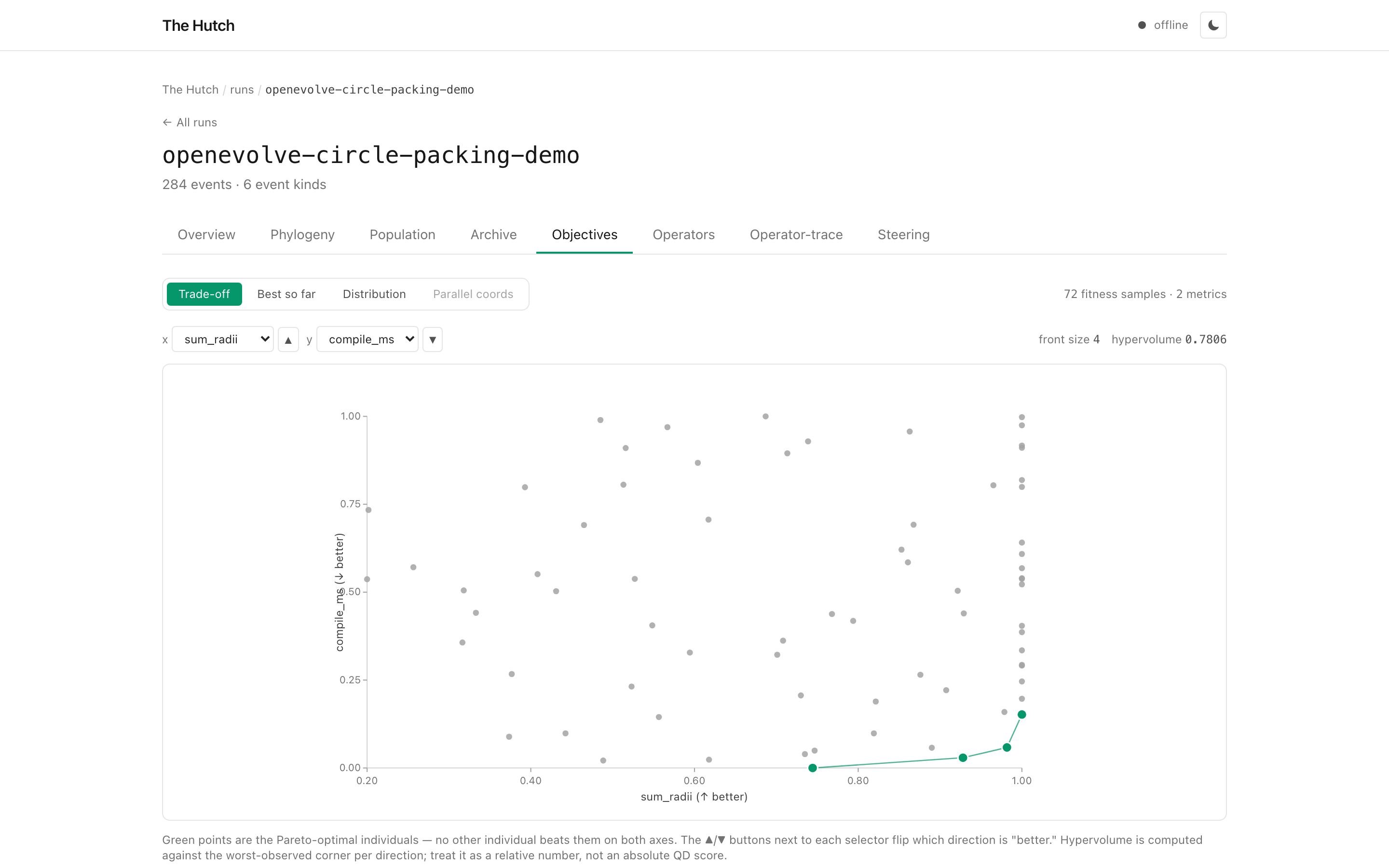 The Objectives view: a trade-off plot between two metrics
(
The Objectives view: a trade-off plot between two metrics
(sum_radii and compile_ms). Green points are the Pareto front;
the hypervolume number summarizes the front's quality.
Lineage
The DAG formed by the parent_ids pointers between Individuals.
- Linear runs collapse to a chain (fanout 1).
- Evolutionary runs are a DAG once you allow crossover.
- Self-improvement is a tree of agent versions.
- Tree search is a tree by definition.
flowchart LR
    A["Individual A<br/>(seed)"]
    B[Individual B]
    C[Individual C]
    D[Individual D]
    op1((refine))
    op2((mutate))
    op3((crossover))

    A --> op1 --> B
    A --> op2 --> C
    B --> op3
    C --> op3 --> D

    classDef ind fill:#eef5ff,stroke:#3b6ca8,color:#1a3a66;
    classDef op fill:#fff4e0,stroke:#a86f1a,color:#5a3d0c;
    class A,B,C,D ind;
    class op1,op2,op3 op;
Boxes are Individuals; circles are Operators. Each Operator has
parent_ids (its inputs) and a child_id (its output), which is how
the DAG forms.
The Phylogeny view in the dashboard renders this as a force-directed graph, and it falls back to a vertical chain on linear runs.
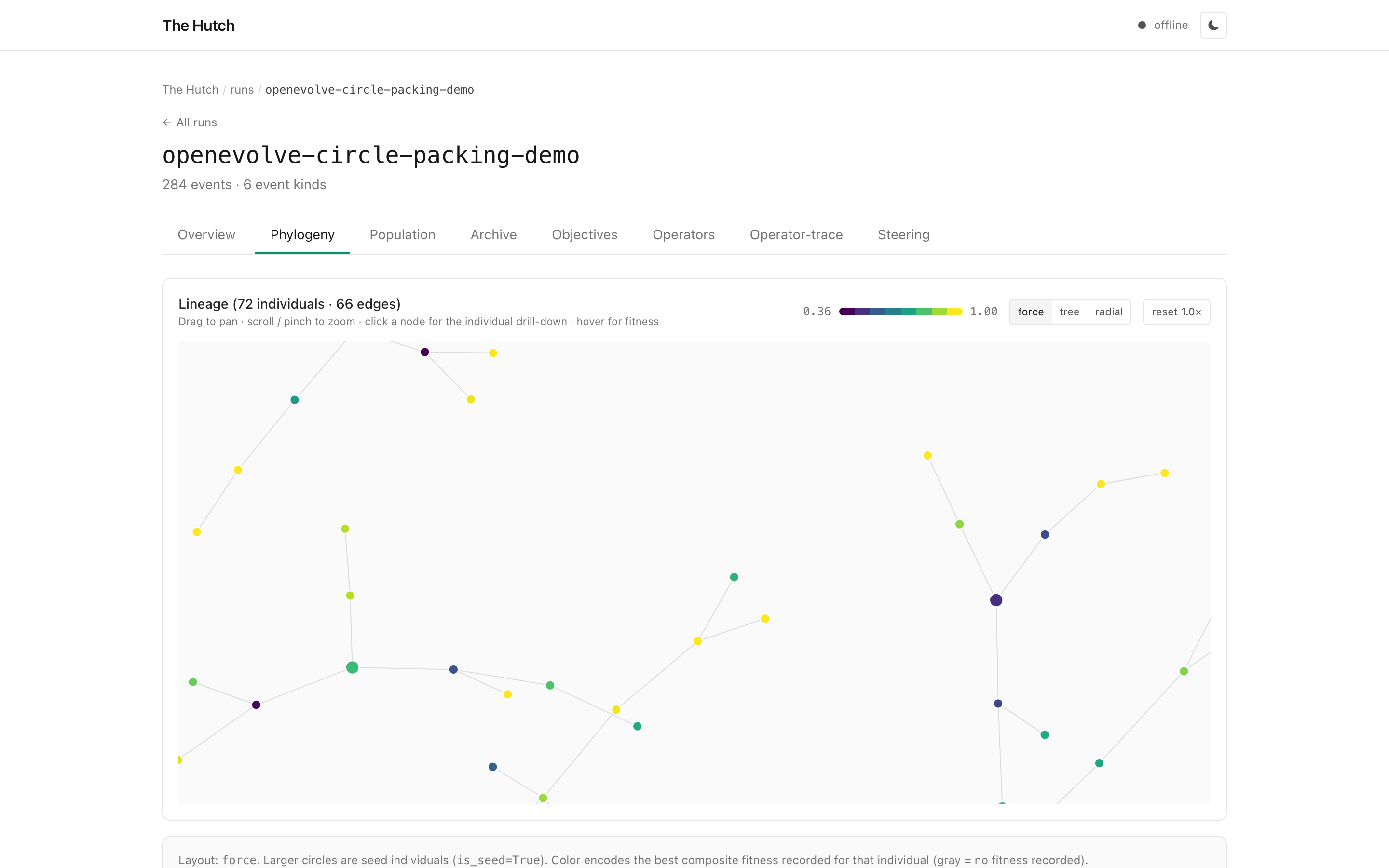 The Phylogeny view for a 72-individual evolutionary run. Larger
circles are seed Individuals; color encodes the best composite fitness
recorded for that Individual (purple → yellow). The same view also
supports tree and radial layouts.
The Phylogeny view for a 72-individual evolutionary run. Larger
circles are seed Individuals; color encodes the best composite fitness
recorded for that Individual (purple → yellow). The same view also
supports tree and radial layouts.
Archive (optional)
A structured collection of Individuals indexed by behavior descriptor rather than fitness. Three flavors are supported today:
- Grid for rectangular MAP-Elites grids.
- CVT (Centroidal Voronoi Tessellation) for descriptors with too many dimensions to grid.
- AURORA for learned latent-space descriptors.
If your run logs no descriptor events, the dashboard hides the Archive
view rather than showing an empty grid. Quality-diversity is opt-in.
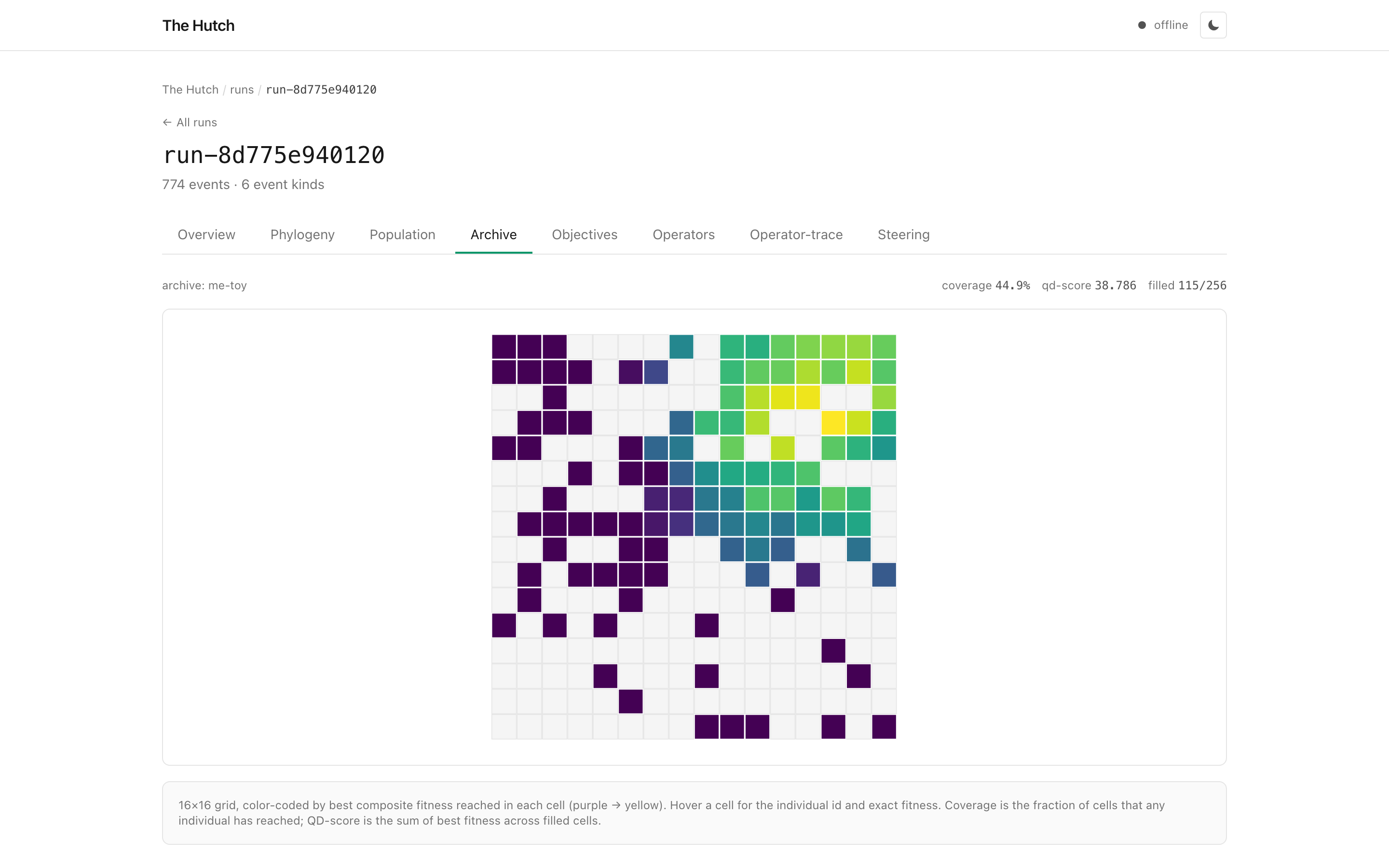 The Archive view for a 16×16 MAP-Elites grid. Each cell is one
behavior bucket; color encodes the best composite fitness reached
there. The header reports coverage (fraction of cells filled) and
QD-score (sum of best fitness across filled cells).
The Archive view for a 16×16 MAP-Elites grid. Each cell is one
behavior bucket; color encodes the best composite fitness reached
there. The header reports coverage (fraction of cells filled) and
QD-score (sum of best fitness across filled cells).
Three structural pieces
These hold the concepts above together. They are less central than the five, but you will see their names in the schema and the docs.
Run
The top-level container. Every event belongs to exactly one run. A run can have multiple populations (parallel islands, for example), multiple archives (a MAP-Elites grid plus a Pareto front), and multiple streams.
Stream (or worker)
A swimlane: one process, one agent role, or one parallel evaluator. ASI-ARCH has Researcher, Engineer, and Analyst streams. OpenEvolve has sampler and evaluator workers. The Operator-Trace view renders one lane per stream.
If a run does not declare streams, every event lives on a single default lane and the swimlane view is just a single timeline.
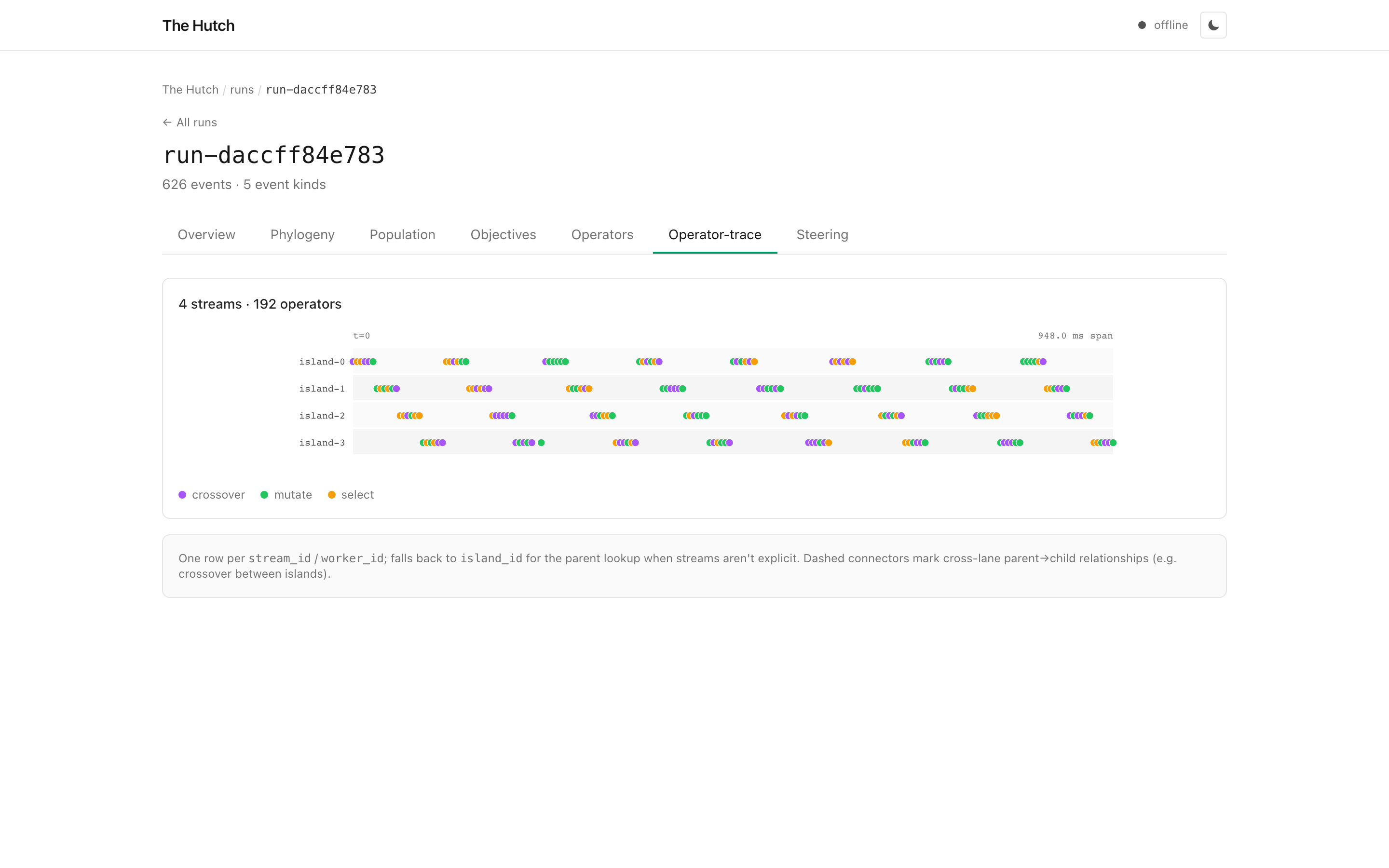 The Operator-trace view for a 4-island evolutionary run, with
operators colored by kind (
The Operator-trace view for a 4-island evolutionary run, with
operators colored by kind (crossover, mutate, select). Each row
is one stream.
Steering Command
A write-back event from the dashboard to the running agent. The
vocabulary is cancel_individual, freeze_island, fork_from,
override_param, pause_run, resume_run, cancel_self_mod,
approve_hitl, and inject_hint.
The agent polls a queue between iterations and executes the commands it receives. This is the mechanism that turns the dashboard from a viewer into a control surface; details are in Steering.
Design notes
A few constraints are deliberate, and worth knowing if you are extending Hutch:
- The model does not assume evolutionary structure. Linear runs render with the same views as evolutionary ones: a population of one, a fanout of one.
- The model does not assume LLM-only evaluation. Wet-lab fitness and
human review are both valid
evaluator_kindvalues. - Lineage is a DAG, not a tree, so arbitrary fanout is fine.
- Multi-objective is native.
is_pareto_frontanddominatesride on the FitnessPayload. - Multiple archives per run is fine; they get different
archive_ids.
If a future system genuinely needs a sixth concept, we will add it. For now, the five hold up.